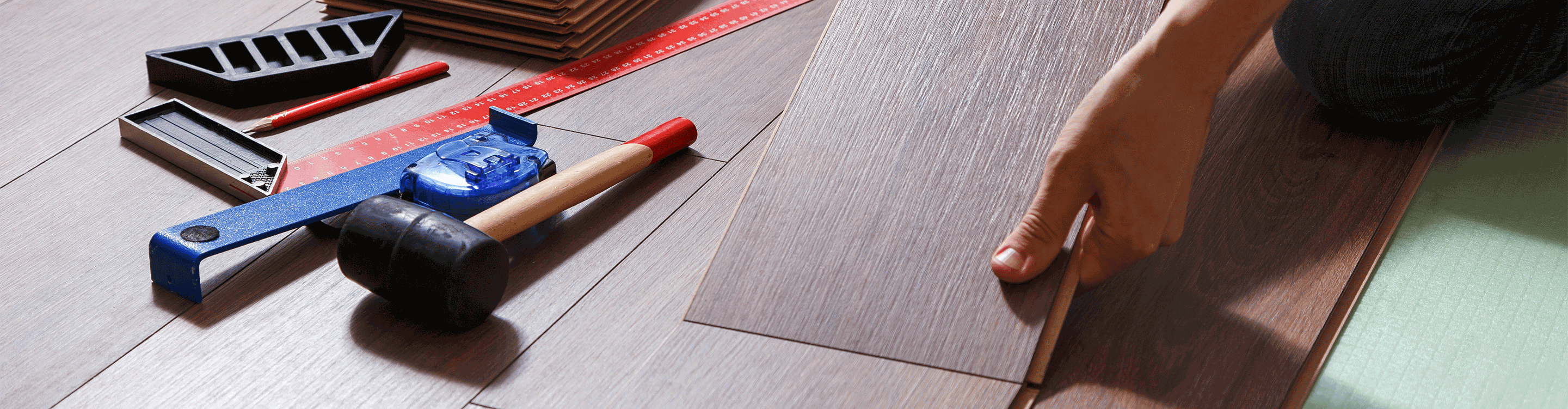
Knowing how to calculate square footage for flooring is the first step in planning your project and setting a realistic budget. Here's what you need to know to get started.
Embarking on a new flooring project marks an exciting chapter in your home's story. Whether you're captivated by the timeless elegance of hardwood or the plush comfort of carpet, the journey from inspiration to installation begins with a crucial first step: understanding your space. While calculating square footage seems straightforward, it's the foundation for your budget and design dreams.
We know that the details matter, from navigating irregular room shapes to accounting for the perfect amount of overage. As your trusted experts, we're here to guide you through the process, ensuring your vision comes to life flawlessly and your investment is sound. Follow our six simple steps to measure your space like a seasoned pro and confidently take the first step toward the beautiful floors you deserve.
Start by gathering measurements of the rooms where you're going to install new flooring. Use a tape measure or download an easy-measure app on your phone, which will allow you to take measurements of the room with your camera. As you probably anticipated, you will be taking length and width measurements of the room and rounding each measurement up to the nearest inch.
For example: If you measure the length of the room as 12 feet, 6 inches, and 9/16th of an inch, you would round up the total measurement to 12 feet and 7 inches.
Convert the measurements that you took in feet and inches to measurements that are strictly in terms of feet. To get the total feet, divide the inches in your measurement by 12 and add that figure to your foot measurement. These totals will be the width and length measurements to use.
For example: If the room is 12 feet and 7 inches in length, you would divide the 7 inches by 12, which equals .583. Add this figure to 12 feet, and your final length is 12.583 feet.
Now, multiply the length of the room by the width of the room to determine the square footage, which is expressed in square feet.
For example: If the room is 12.583 ft. in length and 9.5 ft. in width, you would multiply the two figures (12.583 x 9.5) to determine the square footage, which equals 119.54 square feet.
If the room or area you are measuring is not a perfect square or rectangle, such as an L-shape, you can split it up and treat it as two separate square or rectangular areas. Now, calculate the area of each section separately and add them together for your total.
You can easily convert a square foot measurement to square yards and just as easily convert back if needed. Simply divide the total square footage by 9 to determine square yardage. Similarly, multiply a square yard measurement by 9 to determine square footage.
For example: If the square footage of a room is 119.54 sq ft., you would divide this figure by 3 (119.54 ÷ 9) to determine the square yardage, which equals 13.28 sq yd.
Once you have determined your actual square footage, it’s wise to allow for at least a 5%–10% overage in flooring material to cover any possible installation mishaps or defects noticed during installation. This overage could also be higher depending on the size and shape of the area you're working with, such as rooms with any tricky inlets or areas with odd dimensions.
Laminate flooring, or another type of flooring that can be cut, is an excellent choice to consider if you will need extra material to customize to fit odd dimensions. For carpet installation, it’s best to plan for a 20% overage in flooring material. Add the appropriate overage figure to your square footage, and now you are ready to estimate the flooring cost.
For example: If your total square footage is 119.54 sq ft., you can determine that 10% overage is close to 12 sq ft. (120 sq ft. x .10 = 12 sq ft.). Add the overage figure of 12 sq ft. to 119.54 sq ft. to arrive at a total of 131.54 sq ft., which easily rounds up to 132 sq ft. needed for your project.
Calculating the square footage of a rectangular room is a straightforward process that involves multiplying the length and width of the space. To find the area in square feet, simply measure the length and width of the rectangular room in feet and then multiply these two dimensions. The formula for calculating square footage is area = length × width.
Not all rooms are simple rectangles or squares, which makes the process of calculating square footage a little harder. In such cases, you can break down the irregular shape into smaller, more manageable geometric shapes (such as rectangles, squares, and triangles), calculate the area of each individual shape, and then sum them up to find the total square footage.
To measure square footage, multiply the length and width of the room in feet. In the case of a 12x12 room, simply multiply 12 by 12, resulting in 144 square feet. This uncomplicated formula provides an efficient way to gauge the area of any space.
Now that you know how to calculate square footage, you can confidently estimate the material costs for your dream floor. Whether you're drawn to natural hardwood, classic marble, or waterproof vinyl, this simple calculation is the first step in bringing your vision to life.
Ready to move forward? Our flooring experts are here to help you finalize your budget, navigate additional costs like installation and underlayment, and ensure your project is a success from start to finish.
Schedule your free estimate today and take the next step toward the beautiful space you've been envisioning.
Thank you for contacting Carpet One Floor & Home. Your local flooring expert will reach out to you regarding your inquiry.